
Pop auteur Charli xcx has never been one to treat a music video as a mere promotional tool. Across her career, visuals have served as the ultimate canvas for her world-building—a space where subcultural aesthetics, avant-garde fashion, and meta-commentary collide. 
With the release of “Camera,” a standout single from her album Music, Fashion, Film, Charli doubles down on her visual evolution. Directed by long-time creative collaborator Aidan Zamiri, the music video is a striking, black-and-white, high-concept masterpiece starring iconic French actor Vincent Cassel. It offers a razor-sharp exploration of fame, performance anxiety, and the absurd weight of the spotlight.
1. The Concept: High-Fashion Meta-Cinema in the Desert
Shot as a continuous, black-and-white one-take sequence on a desert movie set, “Camera” leans heavily into cinematic satire.
The narrative centers on Vincent Cassel playing an aging movie star attempting to shoot a melodramatic, bloody death scene. But everything goes wrong: squibs fail to detonate, technical blunders multiply, and equipment sparks in the desert heat.
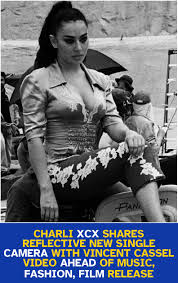
Halfway through the chaos, Charli enters the frame—not as a traditional pop star, but as the director. Perched calmly atop a rolling camera dolly in an embroidered floral capri set, she points a finger gun at Cassel as he spirals into frustration.
It is a brilliant, meta-cinematic allegory. The grueling, repetitive absurdity of the movie set mirrors the song’s underlying lyrical message: the terrifying vulnerability and intoxicating thrill of living life under constant public exposure.
Aidan Zamiri’s Directorial Vision

Aidan Zamiri has emerged as one of the defining directors of contemporary visual culture, and his chemistry with Charli xcx is undeniable.
In “Camera,” Zamiri abandons chaotic quick-cuts in favor of a deliberate single-take shot. This stylistic choice forces the viewer to confront the awkward, unedited reality of production.
Key Visual Highlights:
-
Monochrome Palette: By stripping away color, Zamiri highlights texture, shadow, and architectural structure on the desert set.
-
Juxtaposition of Stars: Pairing the chaotic, visceral intensity of Vincent Cassel with Charli’s stoic, effortless composure creates instant tension.
- Spatial Dynamics: The camera moves fluidly between the micro-details of mechanical mishaps and wide shots capturing the isolation of the desert location.
3. Lyrical & Visual Alignment: “When the Camera is On…”
Lyrically, “Camera” captures Charli wrestling with self-doubt: “Do I want to make music / Am I being fucking stupid?” But when the lens focuses on her, anxiety transforms into power: “When the camera is on / I can be anything I want to be.”
The video mirrors this duality perfectly. Cassel represents the vulnerability of performing—being shot, failing, and dying repeatedly for an audience. Charli represents the creative reinvention that happens behind the lens, taking charge of her own narrative.
4. Why “Camera” Sets a New Standard for Pop Visuals

In an era dominated by short-form TikTok clips, Charli xcx and Aidan Zamiri deliver a patient, high-concept short film that demands undivided attention. “Camera” isn’t just a music video; it’s a piece of performance art that bridges the worlds of music, fashion, and cinema—true to the very title of her album.
“When the camera is on, performance is both a weapon and a refuge.”
Final Verdict
With “Camera,” Charli xcx proves once again that she is miles ahead of the pop curve. Aidan Zamiri’s sharp direction, combined with Vincent Cassel’s magnetic presence, delivers a visual that will be dissected by fashion and film enthusiasts for years to come.