
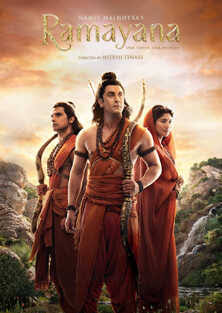
For centuries, Valmiki’s Ramayana has served as far more than an ancient Sanskrit epic—it is the moral, cultural, and spiritual heartbeat of millions across India and the world. Translating a narrative of such staggering emotional intimacy and cosmic scale onto the modern big screen has long been Indian cinema’s ultimate ambition.
Directed by Nitesh Tiwari (Dangal, Chhichhore) and backed by producer Namit Malhotra’s Prime Focus Studios alongside Yash’s Monster Mind Creations, Ramayana arrives as a landmark two-part theatrical event. Anchored by Ranbir Kapoor as Lord Rama, Sai Pallavi as Sita, and Yash as Ravana—and elevated by an unprecedented musical collaboration between A.R. Rahman and Hans Zimmer—the film transforms timeless mythology into breathtaking, large-format global cinema.
1. The Vision: Grounding Cosmic Mythology in Human Emotion
Unlike adaptations that rely solely on spectacle or melodrama, Nitesh Tiwari’s Ramayana approaches the sacred text with reverence, psychological depth, and narrative restraint. Designed specifically as a two-part cinematic saga, the story gives breathing room to the formative relationships, vows, and moral dilemmas that define every character before war erupts across the oceans.
Rather than portraying Lord Rama as an unreachable deity divorced from human struggle, the screenplay emphasizes his quiet restraint, filial devotion, and unwavering commitment to dharma even when obedience costs him his throne and peace. Similarly, Lanka is never reduced to a cartoon realm of monsters; it is envisioned as an opulent, intellectually formidable civilization led by a ruler whose brilliance is tragically undone by unchecked pride.
2. A Pan-Indian Casting Triumph
The backbone of Ramayana is an extraordinary ensemble uniting powerhouse performers from Hindi, Kannada, Tamil, and Telugu cinema—turning the production into a truly pan-Indian artistic milestone.
| Character | Actor |
Narrative & Emotional Role in the Epic
|
| Lord Rama | Ranbir Kapoor |
Portrays the Prince of Ayodhya with serene dignity, physical discipline, and quiet emotional vulnerability.
|
| Goddess Sita | Sai Pallavi |
Brings radiant grace, inner steel, and fearless moral conviction to the heart of the narrative.
|
| Ravana | Yash |
Commands the screen as the ten-headed King of Lanka—a scholar, devotee, and tyrant consumed by ego.
|
| Lord Hanuman | Sunny Deol |
Embodies boundless devotion, towering physical strength, and humble service to Rama.
|
| Lakshmana | Ravi Dubey |
Captures the fierce loyalty, fiery temperament, and selfless sacrifice of Rama’s devoted younger brother.
|
| Kaikeyi | Lara Dutta |
Illuminates the complex insecurity and manipulation that triggers Rama’s fourteen-year exile.
|
| Dasharatha | Arun Govil |
Adds poignant meta-cinematic resonance as the heartbroken King of Ayodhya torn between promise and love.
|
Ranbir Kapoor’s physical transformation—trading modern urban charm for austere stillness, archery mastery, and measured vocal cadence—anchors the film’s spiritual center. Opposite him, Sai Pallavi delivers a luminous performance that frames Sita not as a passive captive, but as a figure of unshakeable resolve. Meanwhile, Yash brings operatic magnetism to Ravana, making the Demon King’s intellect and hubris feel genuinely formidable.
3. Visual Craft & World-Building: DNEG’s Oscar-Winning Scale
To ensure Ramayana stands shoulder-to-shoulder with the finest global fantasy and historical epics, Namit Malhotra enlisted the visual effects powerhouses at DNEG—the eight-time Academy Award-winning studio behind Dune and Interstellar.
Technical Highlights That Elevate the Experience:
-
Contrasting Architectural Worlds: Production design sharply distinguishes the warm, sandstone serenity of Ayodhya and the lush, sun-dappled forests of Dandakaranya from the towering, gold-and-obsidian grandeur of Lanka.
-
Grounded Action Choreography: Instead of weightless wire-work, battle sequences blend traditional Indian martial arts (Kalaripayattu and archery techniques) with visceral, large-scale warfare.
-
Mythological Creatures With Soul: From the Vanara army to Jatayu’s heroic aerial stand, digital artistry prioritizes expressive facial performance and emotional weight over artificial flash.
4. A Historic Musical Fusion: A.R. Rahman Meets Hans Zimmer
Perhaps the most electrifying creative coup behind Ramayana is its score, co-composed by Indian maestro A.R. Rahman and Hollywood legend Hans Zimmer.
“When Indian classical ragas and Vedic chants merge with thunderous orchestral brass, the score doesn’t just accompany the story—it feels ancient and prophetic.”
Rahman infuses the soundtrack with classical ragas, traditional percussion, and soulful vocal motifs that evoke devotion and longing. Zimmer complements those textures with sweeping, thunderous orchestral arrangements and booming low-end motifs whenever Ravana’s armies march or celestial weapons (astras) are invoked. Together, their collaboration creates an unforgettable sonic bridge between Eastern spirituality and global symphonic scale.
5. Cultural Resonance for a Modern Generation
Why does Ramayana feel so vital right now? Because beneath the celestial arrows, golden deer, and stone bridges across the sea lies an intimate examination of human choices. It asks what happens when duty collides with desire, how integrity survives betrayal, and why ego ultimately destroys even the mightiest empires.
By honoring the soul of the original epic while embracing cutting-edge filmmaking technology, Nitesh Tiwari’s Ramayana introduces an eternal story to a worldwide audience without diluting its cultural roots.
The Verdict
With Ranbir Kapoor’s poised central performance, Sai Pallavi’s luminous grace, Yash’s towering turn as Ravana, and the thunderous musical synergy of A.R. Rahman and Hans Zimmer, Ramayana stands as a monumental achievement in Indian filmmaking. It is a rare theatrical spectacle that matches colossal visual ambition with genuine emotional and spiritual depth.